Everyone Can Build an AI App. Almost No One Can Distribute One.
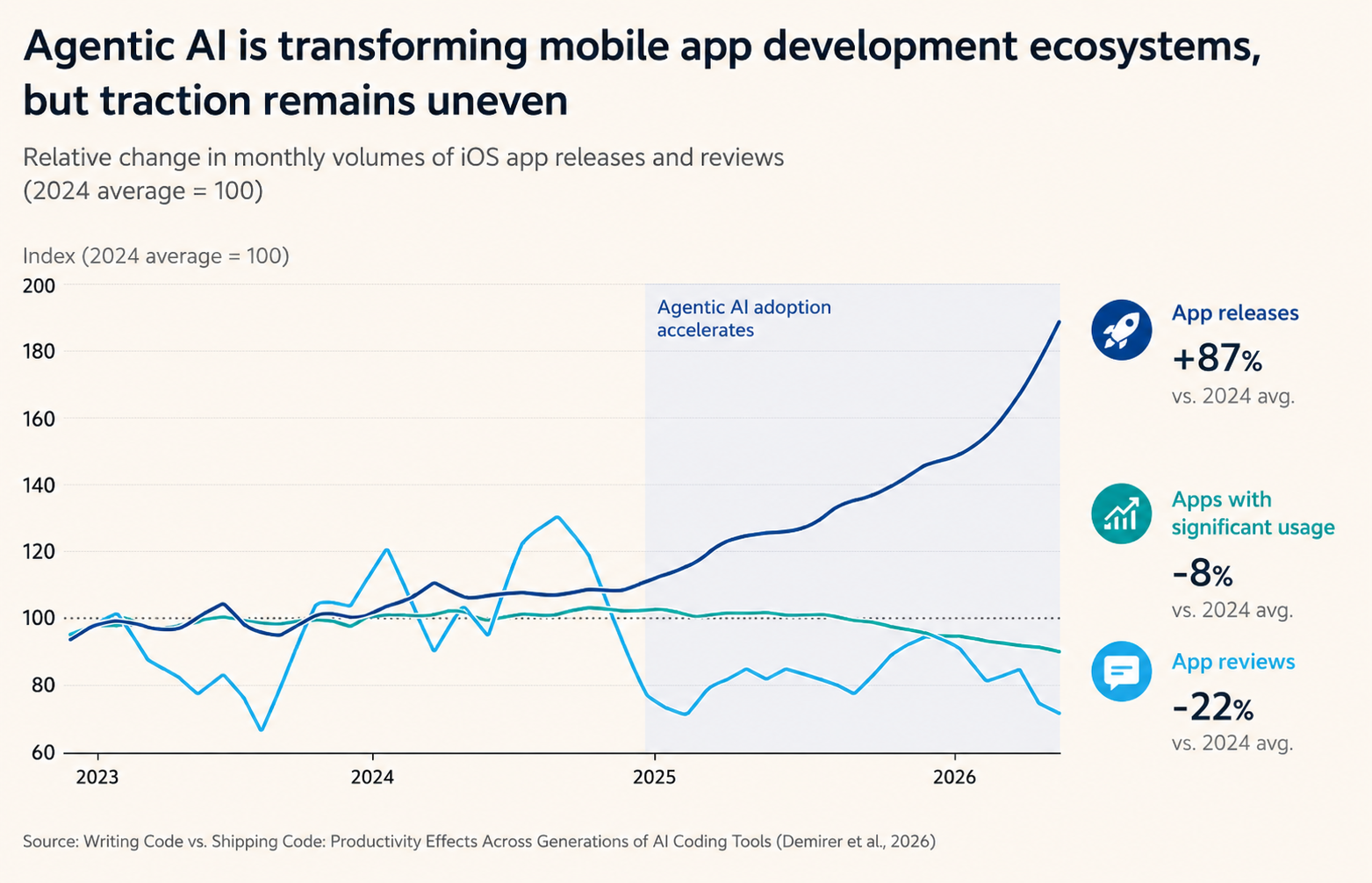
A sleek chart from the Financial Times recently dropped a bombshell. Thanks to agentic AI, iOS app releases have exploded. The line shoots upward like a SpaceX launch starting in late 2024, hitting near-vertical growth by 2026.
Meanwhile, the line for actual app reviews — a decent proxy for real usage — stays stubbornly flat. Almost perfectly horizontal.
Massive output. Complete flat adoption.
We’ve seen this movie before. Only this time, the plot twist is powered by AI.
The Democratization Illusion Agentic AI has done something remarkable: it turned app development from a high-skill, expensive craft into something almost anyone with an idea and a weekend can attempt. No more wrestling with obscure frameworks, hunting for developers, or burning through runway just to ship an MVP.
The barrier to creation has collapsed.
But the barrier to success? That’s standing taller than ever.
Think about it like the printing press. Suddenly everyone could publish books. Did that make every book a bestseller? Of course not. Most became expensive kindling. The winners were the ones who figured out how to get their work in front of readers — through patronage, scandal, brilliant marketing, or sheer distribution muscle.
Today’s app economy works the same way. Only the currency has changed.
The Real Problem Isn’t Building — It’s Being Found Here’s the brutal reality most indie makers and AI enthusiasts don’t want to hear:
Almost nobody has distribution.
You can build something genuinely useful, even delightful, but without one of these, it will likely die in silence:
An existing audience — You’ve spent years building a following on X, TikTok, YouTube, or a newsletter. When you ship, people already care. Money for distribution — The ability to run targeted ads, pay for app store optimization, influencer deals, or user acquisition campaigns. Most solo creators and small teams don’t have this. Creative distribution genius — The rare skill of hacking virality, community building, PR stunts, or guerrilla marketing that costs nothing but imagination and hustle. This is the hardest — and most powerful — path. Most people have none of the above. They have an idea, AI tools, and hope.
Hope isn’t a growth strategy.
Why This Matters More Now Than Ever The agentic AI wave is accelerating the supply side dramatically. Every week brings new stories of “I built a full app in 48 hours with Claude and Cursor.” That’s incredible. But it also means the app stores are becoming noisier, more crowded, and more competitive than at any point in history.
Attention is the ultimate scarce resource. And right now, it’s not flowing to most of these new AI-powered experiments.
Users are exhausted. They’re bombarded with options. They’ve downloaded apps that promised the world and delivered mediocre experiences. Their home screens are full. Their tolerance for “yet another AI wrapper” is plummeting.
The apps that break through will be the ones that solve distribution as thoughtfully as they solve the product problem.
What Actually Works (General Lessons, Not Platitudes) If you’re building in this environment, shift your focus early:
Build for an audience you already understand — The best distribution often starts with people who already know, like, and trust you. Solve a painful problem for your existing community first. Design for shareability from day one — What makes someone want to tell their friends about this? Is it dramatically better, funnier, more useful, or more surprising than alternatives? Engineer the “holy shit” moment. Master asymmetric distribution — Instead of competing in the crowded app store, think about platforms where attention is still somewhat democratized: niche communities, Twitter threads that hit, Substack cross-promotions, or creating content so good people naturally want to share the tool that made it. Be patient with the compound curve — The graph shows releases spiking. Usage doesn’t follow the same pattern. The winners will be those who treat distribution as a long, creative game rather than a launch-and-pray event. The tools are better than ever. The ideas are flowing. But the game hasn’t changed as much as the hype suggests.
The Next Chapter Is Yours to Write Agentic AI didn’t break the fundamental rules of attention and distribution — it just made it easier for more people to play the game.
The question isn’t whether you can build an app anymore. It’s whether you can earn the right to be used.
That part still demands strategy, creativity, and often uncomfortable persistence. The creators who thrive won’t be the fastest shippers. They’ll be the smartest distributors.
The flood of new apps is here. The real winners will be the tiny minority that figure out how to rise above the noise.
What do you think — is distribution the new moat in the AI era, or is there another factor I’m missing? Drop your hottest take in the comments. The discussion is where the real insights live.
Let’s talk about what actually moves the needle.
Discussion
No comments yet. Be the first to share your thoughts!